
Topsoil Tons ↔ Cubic Yards Calculator
Convert topsoil weight into volume (or volume into weight), adjusted for soil condition, ordering buffer, and coverage area.
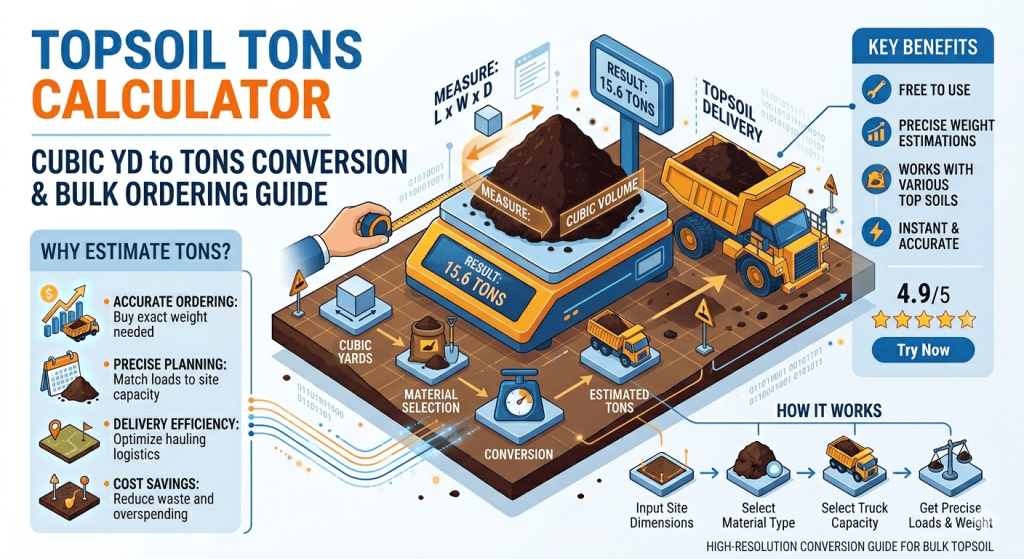
If your topsoil supplier sells material by the ton, you’ve likely realized that estimating soil needs suddenly feels more complicated.
New to buying soil by weight? Start with our complete guide to what topsoil is, including how it is graded and what to check before you order.
Most homeowners measure projects in square feet or cubic yards, but weight-based ordering introduces new questions.
How much does topsoil actually weigh? Why do estimates vary so much? And how many tons should you order to avoid coming up short?
This Topsoil Tons Calculator is designed to answer those questions clearly. It helps you convert between cubic yards and tons — whether you’re working in yards, CY, or cubic meters — while also estimating how much area that weight of soil will realistically cover.
Converting gravel, sand, mulch, or another material? The Yards to Tons Calculator has presets for 19 materials.
How Much Does a Ton of Topsoil Weigh?
This sounds like a trick question, but it’s one of the most common things people search for — and it’s worth answering directly.
If a supplier quotes by the ton, our guide to topsoil cost per yard and per ton shows how to convert the price.
A ton is always a ton. In the US, one short ton equals 2,000 lbs. In the UK, Canada, and metric markets, one tonne (metric ton) equals 1,000 kg, about 2,205 lbs. A tonne of topsoil weighs the same as a tonne of anything else — what changes is how much space it takes up.
What people are really asking when they type this is: how much volume does a ton of topsoil actually represent? And that depends on soil condition. One US ton of dry topsoil takes up roughly 1.0 cubic yard. A ton of average topsoil takes up about 0.83 cubic yards, and a ton of wet, compacted topsoil takes up less space — about 0.71 cubic yards.
Flip it around: one cubic yard of dry to moderately moist topsoil weighs roughly 1.0 to 1.2 tons in most sources. A yard of dry topsoil sits at the lower end (around 1.0 ton). Wet or compacted soil pushes toward 1.4 tons or beyond.
How Much Does Topsoil Weigh?
Unlike volume, topsoil weight is not fixed. Two piles of soil that look the same size can weigh very differently depending on their condition. The main factors that affect topsoil weight are moisture content, compaction, and organic material.
Dry, loose topsoil is lighter and easier to spread. Average topsoil that has normal moisture weighs more, while wet or compacted soil can be significantly heavier. Rainfall alone can increase soil weight enough to change delivery totals.
Because of these variables, suppliers usually work with weight ranges rather than exact numbers, which is why calculators that assume one fixed conversion often lead to inaccurate orders.
Topsoil Yards to Tons — Conversion Explained
Cubic yards measure volume, while tons measure weight. Converting topsoil CY to tons requires understanding soil density. On average, one cubic yard of topsoil weighs between 1.0 and 1.4 tons, depending on moisture and compaction.
Here’s a quick reference for common project sizes:
| Cubic Yards (cy) | Dry Topsoil | Average Topsoil | Wet Topsoil |
|---|---|---|---|
| 1 yard | ~1.0 tons | ~1.2 tons | ~1.4 tons |
| 4 yards | ~4.0 tons | ~4.8 tons | ~5.6 tons |
| 5 yards | ~5.0 tons | ~6.0 tons | ~7.0 tons |
| 10 yards | ~10 tons | ~12 tons | ~14 tons |
| 15 yards | ~15 tons | ~18 tons | ~21 tons |
| 20 yards | ~20 tons | ~24 tons | ~28 tons |
Going the other direction — tons to cubic yards:
| Weight (tons) | Dry Topsoil | Average Topsoil | Wet Topsoil |
|---|---|---|---|
| 1 ton | ~1.0 yd³ | ~0.83 yd³ | ~0.71 yd³ |
| 5 tons | ~5.0 yd³ | ~4.2 yd³ | ~3.6 yd³ |
| 10 tons | ~10.0 yd³ | ~8.3 yd³ | ~7.1 yd³ |
| 15 tons | ~15.0 yd³ | ~12.5 yd³ | ~10.7 yd³ |
| 20 tons | ~20.0 yd³ | ~16.7 yd³ | ~14.3 yd³ |
So if someone asks how many tons is 5 yards of topsoil — dry soil comes in around 5 tons, average moist soil around 6 tons. How many tons is 10 yards of topsoil? Roughly 10 to 14 tons depending on condition. That range is why knowing your soil’s moisture state before ordering matters.
For metric projects, the three presets work out to about 1.2 t/m³ for dry topsoil, 1.4 for average and 1.7 for wet. To convert m³ to tonnes, multiply your cubic meter volume by about 1.4 as a working average.
How Many Yards of Topsoil Are in a Ton?
This is the reverse conversion — and just as useful if you already know the weight you’re getting delivered.
One ton of topsoil is roughly 0.7 to 1.0 cubic yards depending on condition, with about 0.83 for average soil. So:
- 1 ton of topsoil → about 0.7–1.0 cubic yards → roughly 19–27 cubic feet
- 5 tons of topsoil → about 3.6–5.0 cubic yards
- 10 tons of topsoil → about 7.1–10 cubic yards
If you’re wondering how big a 1-ton pile of topsoil actually looks: picture a cube roughly 3 feet on each side — that’s close to a cubic yard, and one ton sits right in that range for average soil.
How the Topsoil Tons Calculator Works
This calculator allows you to start with either volume or weight. You can enter cubic yards or cubic meters and select a soil condition such as dry, average, or wet. The calculator then estimates the corresponding weight in tons and shows how much area that amount of soil can cover at typical depths.
By accounting for soil condition, the calculator reflects real-world ordering scenarios rather than idealized lab values.
How Much Area Does One Ton of Topsoil Cover?
Coverage depends on both weight and depth. At shallow depths, one ton of topsoil can cover a surprisingly large area. As depth increases, coverage decreases quickly.
At approximately one inch deep, a ton of average topsoil can cover several hundred square feet. At three inches deep, that same ton may cover less than half that area. This is why many people underestimate their needs when planning deeper soil layers.
Understanding this relationship between depth and coverage is essential when ordering topsoil by weight. If you need to know how much does 1 ton of topsoil cover for a specific project depth, use the calculator above — it gives you the exact figure based on your conditions.
Example Topsoil Weight Calculations
Consider a project that requires five cubic yards of average topsoil. Using the average preset of 1.2 tons per cubic yard, this equals about six tons. If the soil is wet (1.4 tons per cubic yard), that same volume comes to about seven tons.
If you already know you are ordering ten tons of topsoil, the calculator can estimate how much ground that weight will cover. At a depth of two inches, those ten tons may be sufficient for a medium-sized lawn. At four inches, coverage will be much smaller.
These examples show why converting between topsoil tons and yards before ordering is so important — whether you call it yards to tons topsoil or dirt yards to tons, the math works the same way.
Should You Order Extra Topsoil by Weight?
Ordering topsoil by tons leaves little margin for error. Moisture changes, compaction during transport, and spreading losses can all reduce usable soil volume. For this reason, most professionals recommend ordering 5–15% extra topsoil by weight.
Smaller, precise projects may need only a small buffer, while larger or uneven areas benefit from a higher allowance. Ordering slightly more soil is usually far cheaper than paying for a second delivery.
Common Mistakes When Ordering Topsoil by Tons
One common mistake is assuming a fixed conversion between cubic yards and tons. Another is ignoring how wet soil affects weight, especially after rainfall.
Some buyers also confuse tons with truckloads, which are separate delivery considerations. And a lot of people forget that “dirt” and “topsoil” behave the same way in these calculations — converting yards of dirt to tons uses exactly the same density ranges.
Failing to include a buffer is another frequent issue. Ordering the exact calculated amount often leads to shortages once soil settles or spreads unevenly.
When to Use a Different Calculator
This calculator is designed specifically for weight-based ordering. If you are still determining the total volume of soil needed from length, width, and depth, start with a general topsoil volume checker first.
For delivery planning by dump truck size, a truckload calculator is more appropriate. If you need pricing and delivery cost estimates, a topsoil cost estimator will provide better results. For small projects using bagged soil, a bags-of-topsoil estimator is the right choice.
The yards to tons calculator is also useful for straightforward volume-to-weight conversions on other construction projects, not just topsoil.
Frequently Asked Questions
How many tons are in a cubic yard of topsoil?
On average, one cubic yard of topsoil weighs between 1.0 and 1.4 tons, depending on moisture and compaction. Dry topsoil sits at the lower end; wet, dense soil pushes higher.
How many tons is a yard of topsoil — in simple terms?
For everyday planning, treat 1 yard of topsoil as roughly 1.2 tons. That’s the average setting, and several supplier price pages imply the same figure.
How many tons is 10 yards of topsoil?
Roughly 10 to 14 tons depending on soil moisture. Dry soil comes in closer to 10 tons; wet soil can reach 14 or more for the same volume.
How many tons is 5 yards of topsoil?
About 5 to 7 tons. Average moist topsoil at 5 yards works out to around 6 tons.
How many yards of topsoil are in a ton?
Approximately 0.7 to 1.0 cubic yards per ton. For average soil, about 0.83 yards per ton is a reasonable working figure.
How many cubic feet are in a ton of topsoil?
One ton of topsoil is roughly 19 to 27 cubic feet (since 1 cubic yard = 27 cubic feet and 1 ton ≈ 0.7–1.0 yards), or about 22.5 cubic feet for average soil.
What is the bulk density of topsoil in tons per cubic yard?
Standard topsoil bulk density runs 1.0 to 1.4 short tons per cubic yard, or roughly 1.2 to 1.7 metric tonnes per cubic meter.
How much does topsoil weigh when wet?
Wet topsoil can weigh significantly more than dry soil, and in the calculator the wet preset is 1.4 tons per cubic yard against 1.0 for dry soil.
How much does a ton of topsoil cost?
Topsoil pricing varies widely by region and quality. Screened topsoil typically costs more than unscreened fill. For total cost with delivery, use the topsoil cost calculator.
How much topsoil do I need for 1,000 square feet?
It depends on depth. At one inch deep, fewer tons are required than at three or four inches. Run your numbers through the calculator above for an exact answer.
Is topsoil sold by weight or volume? Some suppliers sell by cubic yard, while others sell by ton. Always confirm before ordering.
How much does a tonne of topsoil weigh?
A tonne (1,000 kg, used in the UK, Canada, Australia, and metric markets) is a fixed weight — what changes is the volume. On the three presets a tonne of topsoil is roughly 0.6 to 0.84 cubic meters (about 0.8 to 1.1 cubic yards), or about 0.7 cubic meters for average soil. Dry topsoil takes up more space per tonne; wet, compacted topsoil takes up less.
Does dirt weigh the same as topsoil?
For conversion purposes, yes — plain dirt, fill dirt, and topsoil all fall in the same general density range (roughly 1.0 to 1.4 tons per cubic yard), so “how many tons in a yard of dirt” and “how many tons in a yard of topsoil” use the same math. Heavier clay-based dirt can run slightly higher.
¿Cuántas yardas son una tonelada de tierra?
Una tonelada corta (2,000 lbs) de tierra o tierra vegetal equivale aproximadamente a 0.7–1.0 yardas cúbicas, dependiendo de la humedad. Usa la calculadora de arriba para una conversión exacta. (In English: one short ton of soil is about 0.7–1.0 cubic yards.)
How accurate are ton-based estimates? They are reliable when soil condition is considered, but adding a buffer improves accuracy.
Final Thoughts
Ordering topsoil by the ton doesn’t have to be confusing. By understanding how soil weight varies and using a calculator that accounts for real-world conditions, you can place accurate orders with confidence.
This Topsoil Tons Calculator helps bridge the gap between volume measurements and weight-based ordering, allowing you to plan efficiently, avoid delays, and keep your project on track.
Daniel
Founder & Editor – TopSoilCalcOnline.com
Daniel is the founder and primary editor of TopSoilCalcOnline.com, a practical resource built to help homeowners, landscapers, and contractors accurately calculate topsoil, compost, and soil mix requirements. With hands-on experience in lawn preparation, raised beds, topdressing, and bulk soil planning, Daniel focuses on turning complex volume calculations into simple, reliable tools. Every calculator and guide on this site is designed to reduce material waste, prevent over-ordering, and help users plan landscaping projects with confidence and precision.