
Not sure how much topsoil you need? This topsoil calculator gives you your number in cubic yards, cubic meters, cubic feet, tons, or tonnes. Best estimator for lawn top dressing, raised garden beds, flower borders, and full landscaping jobs. Enter your area width, length, depth, and bag size, and it tells you how many bags to buy and what it will cost. No guessing, no overpaying, no short deliveries.
Topsoil Calculator
Pricing info
More Topsoil Estimator
Need a different number for your project? These calculators cover everything from lawns and raised beds to truckloads, bags, and cost — pick the one that matches what you’re working on.
What Is Topsoil?
Topsoil is the top layer of earth, usually the first 2 to 8 inches, where most of a plant’s roots do their work. It’s darker and richer than the soil underneath because it holds the organic matter, nutrients, and microbes that keep plants alive.
For grades, composition, what topsoil is used for and how it differs from garden soil, read our full guide: What Is Topsoil?
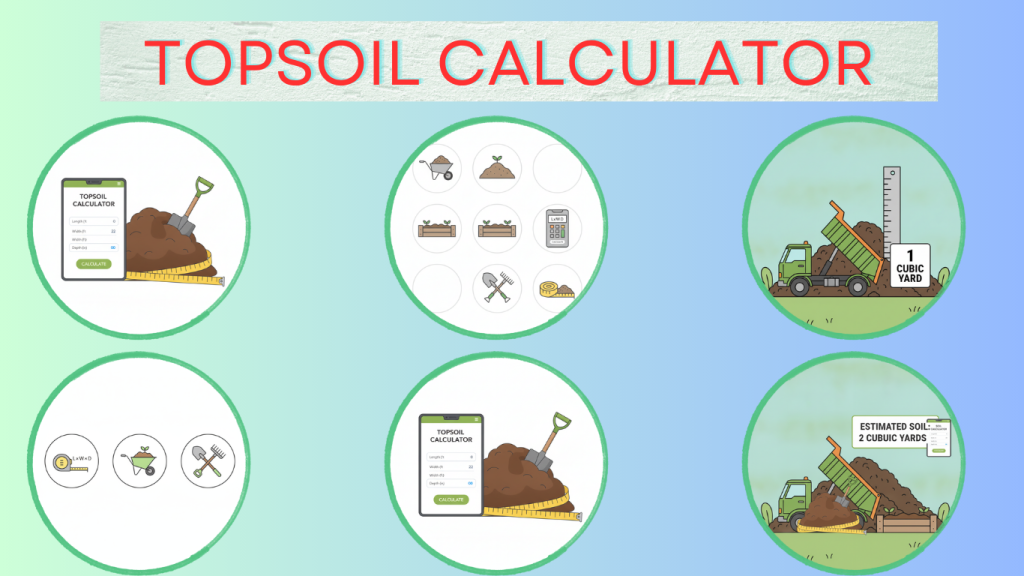
How To Calculate Topsoil For Your Project
To calculate topsoil by manually is very simple. You just need to find your area’s length, width, and depth in feet.
Here is how to do the math step-by-step.
Step 1: Measure Length and Width
Grab a tape measure and get the length and width of your space in feet.
-
Tip: If your yard is an odd shape, just split it into smaller rectangles, measure each one, and add them together at the end.
Step 2: Convert Depth to Feet
We usually think of soil depth in inches, but you need it in feet for the math to work. Just divide your inches by 12.
Here are the quick shortcuts:
-
2 inches = 0.17 feet
-
3 inches = 0.25 feet
-
4 inches = 0.33 feet
-
6 inches = 0.50 feet
Step 3: Multiply Them Together
Multiply your length, width, and depth to get your total Cubic Feet.
Length (ft) x Width (ft) x Depth (ft) = Cubic Feet
Example: A 10ft x 4ft garden bed that needs 6 inches of soil (0.50 ft) looks like this: 10 x 4 x 0.50 = 20 Cubic Feet.
Step 4: Convert to Yards, Bags, or Tons
Most suppliers don’t sell soil by cubic feet, so you will need to convert your final number:
-
For Cubic Yards: Divide your total cubic feet by 27. (Using our example: 20 ÷ 27 = 0.74 cubic yards).
-
For Bags: Standard retail bag sizes vary (like 25, 40, 50, or 60 liters). To find the exact count you need, just plug your measurements into our topsoil bag Estimator tool.
-
For Tons: Weight changes depending on how wet the soil is. If you are ordering a large commercial truckload, skip the manual guessing and use our topsoil tons Calculator.
-
Why Use a Topsoil Estimator?
-
To order topsoil for your lawn or garden seems straightforward. But most people get stuck on one question: how much do I actually need?
That’s where wrong estimates take place.
In the United States, suppliers ask for cubic yards, some sell by the ton, others by the bag, their weight in liters. A correct estimate depends on the depth you need to fill for your project. Laying sod is different from over-seeding a lawn. Filling a raised bed is different again.
So people guess first. They eyeball the yard, pick a number, and order. Then they either run short and reorder, or they’re left with a pile of soil they don’t need.
It happens because they never measured their area properly. Depth, area, volume — nobody thinks about these until it’s too late.
A topsoil calculator solves this. Enter your length, width, and depth. It gives you the number. No math. No guessing.
Whether you’re a homeowner or a contractor, this calculator gives you one clear answer before you order.
Why Most People Order the Wrong Amount Of Top soil?
Most people measure their square footage and stop there. But topsoil is a three-dimensional material. Depth matters just as much as surface area. Even a small change in depth can throw your whole estimate off.
And that’s where the mistakes happen. The most common ones are:
- You measured the area but ignored the depth.
- You forgot that soil spreads and settles once it’s laid.
- You mixed up cubic yards, cubic feet, and bags.
Any one of these can cost you. Either you overpay for soil you don’t use, or you run short halfway through the job and have to stop everything for a second delivery.
How This Calculator Gives You an Accurate Soil Estimate
I built this calculator around how topsoil is actually sold and used. It’s not just a math formula.
Here’s what you get:
- Enter your length, width, and depth — it calculates the volume for you.
- Switch between imperial and metric whenever you want.
- Add a waste factor for settling and uneven ground.
- See your results in cubic yards, cubic meters, liters, bags, tons, or truckloads.
One thing to keep in mind: everything starts with volume. That number drives your whole order. Get that right and the rest falls into place.
If your project has an odd shape — a circle, an L-shape, or several separate beds — don’t force it into one box. Use the Circular Area Topsoil estimator for round beds.
How to Measure Your Yard for an Accurate Topsoil Estimate
Accurate input makes a bigger difference than any adjustment you do later.
Good results come from good inputs. A small measuring mistake can throw your whole order off. Let me walk you through it simply.
1. Measure Your Area Properly
Use a measuring tape or a wheel to get your actual length and width. Don’t estimate — measure it yourself. Two minutes of measuring will save you from a wrong order.
This is where most people go wrong. They pick a random number instead of matching the depth to the actual project. Here’s a simple table to help you plan the depth for your project:
| Project Type | Recommended Depth | Why It Matters |
|---|---|---|
| New Lawn (sod or seed) | 4 – 6 inches | Gives roots room to grow and helps the lawn handle dry spells |
| Flower Bed or Border | 8 – 12 inches | Lets roots spread out properly so plants stay healthy |
| Vegetable Bed | 12 inches | Nutrient-rich depth that supports heavy feeders like carrots and tomatoes |
The rule is simple: match the depth to your project, not to your guess. Filling a raised bed from scratch?
3. Always Include a Waste Factor
Most people skip this step, but it’s actually a trick that saves you from running short and having to reorder. Don’t let that happen to you.
Adding a waste factor is simple. It just means ordering a little extra on top of your measurement. Here’s how much to add depending on your project:
| Project Type | Waste Factor | When It Applies |
|---|---|---|
| Standard Lawn or Garden | 10% – 15% | Works for most home projects |
| Heavy Compaction | 20% – 25% | When you’re using a compactor or roller |
| Rough or Uneven Ground | 15% – 20% | When your area has dips, holes, or uneven patches |
Why You Should Buy Some Extra
Because:
- Compaction — Topsoil settles after you spread it. Rain pushes it down and foot traffic packs it in. What looks like enough today won’t be enough tomorrow.
- Uneven ground — When you measured your area, you couldn’t see every hidden dip or low spot. That extra soil fills those gaps without a second trip to the supplier.
- Cost — One slightly bigger order is always cheaper than two separate deliveries. That second delivery means paying another delivery charge on top. Get it right the first time and you save both time and money. If you want to see exactly what that extra yard costs before you commit, run it through the Topsoil Cost estimator.
How Much Topsoil Do You Need for an Area, Measured in Square Feet?
As we already discussed, whether you need bagged or truckload topsoil depends on depth. Here’s a quick guide answering the common question: how much topsoil do I need for 5000, 2000, 1000, 500, or 600 square feet?
| Area (Sq. Ft.) | At 2-Inch Depth | At 4-Inch Depth | At 6-Inch Depth |
|---|---|---|---|
| 100 sq ft | 0.62 cu yd (17 bags) | 1.23 cu yd (34 bags) | 1.85 cu yd (50 bags) |
| 200 sq ft | 1.23 cu yd (34 bags) | 2.47 cu yd (67 bags) | 3.70 cu yd (100 bags) |
| 400 sq ft | 2.47 cu yd (67 bags) | 4.94 cu yd (134 bags) | 7.41 cu yd (200 bags) |
| 500 sq ft | 3.09 cu yd (84 bags) | 6.17 cu yd (167 bags) | 9.26 cu yd (250 bags) |
| 600 sq ft | 3.70 cu yd (100 bags) | 7.41 cu yd (200 bags) | 11.11 cu yd (300 bags) |
| 1,000 sq ft | 6.17 cu yd (167 bags) | 12.35 cu yd (334 bags) | 18.52 cu yd (500 bags) |
| 2,000 sq ft | 12.35 cu yd (334 bags) | 24.69 cu yd (667 bags) | 37.04 cu yd (1,000 bags) |
| 3,000 sq ft | 18.52 cu yd (500 bags) | 37.04 cu yd (1,000 bags) | 55.56 cu yd (1,500 bags) |
| 5,000 sq ft | 30.86 cu yd (834 bags) | 61.73 cu yd (1,667 bags) | 92.59 cu yd (2,500 bags) |
Got several separate areas to fill — say a bed out front and a bigger one out back? Add them up in one go with the Multi-Area Topsoil estimator instead of running the numbers twice.
40 lb Bag of Topsoil: How Many Cubic Yards Is It?
Sellers offer topsoil bags in different sizes. So when someone asks: a 40 lb bag of topsoil is how many cubic yards? — here’s the answer.
A standard 40 lb bag of topsoil equals roughly 0.028 cubic yards. Topsoil is sold by weight but measured in cubic yards, and the exact number shifts a bit depending on moisture level and the soil’s density. On average, dry-to-moist topsoil weighs somewhere between 1,400 and 1,600 lbs per cubic yard. Using a standard average of 1,500 lbs per cubic yard, one cubic yard works out to about 30 to 40 bags, depending on how damp the soil is.
People also ask how this compares to plain fill dirt. A 40 lb bag of dirt covers roughly the same ground, so if you’re mixing bagged dirt with bagged topsoil, don’t assume the coverage is identical — dirt tends to be denser and heavier per bag.
For quick reference, here’s how cubic yards break down into the units suppliers actually quote:
| Unit | Equals |
|---|---|
| 1 cubic yard | 27 cubic feet |
| 1 cubic yard | ≈ 764.5 liters |
| 1 cubic yard of topsoil | 1,400 – 1,600 lbs (roughly 0.7 – 0.8 tons) |
| 1 cubic yard | 30 – 40 bags (40 lb bags) |
So how big is a yard of topsoil, really? Picture a cube 3 feet long, 3 feet wide, and 3 feet tall — that’s one cubic yard. It’s enough to cover roughly 100 square feet at a 3-inch depth, or about 324 square feet at a 1-inch depth. If you’d rather skip the mental math and just get a straight tonnage figure, the Topsoil Tons tool to converts your volume for you.
How to Read and Use Your Results
You entered your measurements and got your number. Now you need to know how to use it, because topsoil isn’t sold the same way everywhere.
How Topsoil Is Delivered in the United States
Topsoil is sold by the cubic yard. You have three choices:
- Bags — Small retail bags, usually 0.75 or 1 cubic foot. Each bag runs about $3 to $6. Good for small touch-ups but gets expensive fast on bigger jobs. Work out the exact count with the Bags of Topsoil estimator
- Truckload — Best when you need more than 2 cubic yards. The driver tips the load straight onto your driveway. It’s the cheapest way to buy in bulk, but you need room to take the delivery. Check load sizes with the Topsoil Truckload tool.
- Super Sacks — These hold around 1 cubic yard each. They work well in cities where a dump truck can’t get through. Just know that delivery can get tricky on narrow streets.
How Top soil Is Delivered in Canada
Works mostly like the US, but big bags are more popular in residential neighborhoods.
- Big Bags — Cities like Toronto, Vancouver, and Ottawa use these a lot. Suppliers drop a 1 cubic yard bag at your door. Clean, simple, no mess on the driveway.
- Bulk Loose — For bigger jobs, suppliers sell by the cubic yard, same as the US.
How Top soil Is Delivered in the UK
The UK sells topsoil by weight, not volume. So your calculator result in tonnes is what matters here.
- Bulk Bags — Most home deliveries come in builders’ bags holding 850kg to 1,000kg. Dropped at your door, easy to work from.
- Loose Loads — Bigger renovation jobs get a tipper truck delivery. More soil, lower cost per tonne.
- Small Bags — 20kg to 25kg bags for small garden patches. Easy to carry, but you pay more per tonne compared to bulk.
Can You Put Topsoil Over Grass and Reseed?
Yes. A thin, even layer of screened topsoil, about a quarter to half an inch, can go over a thin lawn before you reseed, but a thick layer smothers the grass. Our lawn soil guide covers depths and materials, and the topdressing calculator sizes the job.
Can You Use Top soil for Potted Plants?
You can, but it is not ideal on its own, because it is denser than potting mix and drains poorly in a container. Our guide to topsoil vs garden soil vs potting soil explains what to mix it with for pots.
Practical Topsoil Calculation Examples
A) Lawn Top-Dressing Example
A 1,000 sq ft lawn top-dressed at 0.5 inches usually requires less than one cubic yard. Many homeowners over-order because they assume it needs much more.
B) New Lawn Installation
The same lawn at 3 inches depth needs several cubic yards. This is where accurate calculation prevents shortages and delays.
C) Raised Garden Beds
Raised beds require full depth across the entire footprint. Calculating by area alone often underestimates soil needs by hundreds of liters.
Tips & Suggestions
- Round up, not down — suppliers rarely deliver partial yards accurately.
- Soil settles after rain — fresh topsoil can lose 10–20% height after watering.
- Bulk is cheaper past 2 yards — bagged soil makes sense only for small areas.
- Depth matters more than area — doubling depth doubles volume instantly.
- Ask about moisture content — wet soil weighs more but covers the same volume.
These small details make a big difference in cost and project timing.
Frequently Asked Questions
1. How much topsoil do I need per square foot?
Topsoil needed depends on depth. At 1 inch depth, one cubic yard covers about 324 square feet. At 3 inches, coverage drops to about 108 square feet.
2. How many bags of topsoil make a cubic yard?
It depends on bag size. A cubic yard equals roughly 67 bags of 40-liter topsoil, or 54 bags of 50-liter topsoil. In 40 lb bags, that’s closer to 30–40 bags depending on moisture.
3. Should I buy topsoil by weight or volume?
Volume is more reliable. Weight varies with moisture content, while volume stays consistent.
4. How accurate is this topsoil calculator?
The calculator uses standard industry formulas. Adding a waste factor improves accuracy for real-world conditions.
5. Can I use this calculator for sod and turf?
Yes. Use a depth of 2–3 inches for sod or turf preparation, or head straight to the sod topsoil tool for a depth range already set for you.
6. How many cubic feet are in a cubic yard?
27 cubic feet make up one cubic yard — that’s 3 feet × 3 feet × 3 feet.
7. How big is a yard of topsoil?
Picture a cube measuring 3 feet on every side. That’s one cubic yard — enough to cover about 100 square feet at 3 inches deep.
8. What’s the difference between topsoil and garden soil?
Garden soil is topsoil that’s already been enriched with compost and other organic matter. Topsoil on its own is better for large-volume jobs like lawns and fill; garden soil is better suited to planting beds where plants need extra nutrients right away.
9. Does this calculator work for Canada and the UK?
Yes. Switch the unit setting to metric and the calculator returns your result in cubic meters or tonnes, matching how suppliers in Canada and the UK actually sell topsoil.
10. How many liters are in a cubic yard of topsoil?
One cubic yard of topsoil equals about 764.6 liters (litres), or roughly 0.765 cubic meters — useful if your supplier quotes in metric instead of cubic yards.
11. Can this help me find topsoil for sale near me?
This calculator doesn’t list local suppliers, but it tells you exactly how many cubic yards, bags, or truckloads to ask for — so you get an accurate quote the first time you call a topsoil supplier near you.
Final Words
This calculator was built for real projects, not rough guesses. If you want a number you can actually trust, measure your area properly. Get your depth right. Add your waste factor. Do those three things and you’ll order exactly what you need — nothing more, nothing less.
Use this calculator to confirm your quantity before you buy. Compare your purchase options. Whether you’re spreading a thin top dressing or filling a raised bed from scratch, the process is the same — put in real numbers and get a real answer.
Hope this helped you figure out exactly what you need before you order.
Explore the Full Calculator Library
This topsoil calculator covers volume, weight, bags, cost, and truckloads — but the site has 30+ more tools for other materials and project types. Here’s the full list, grouped by what you’re working on.
Weight, Volume & Unit Conversions
Converting between units or need an exact weight instead of volume? These handle it:
- Liters of Soil to Weight Calculator — convert liters to kg or lbs, for soil, potting mix, or plain water
- Bushel to Kg/Tonnes Converter
- Yards to Tons Calculator
- Soil Coverage Calculator — how much area your soil actually covers
- Square Feet to Cubic Yards Calculator
Other Materials: Mulch, Sand, Gravel & More
Not every project is topsoil. These calculators use the same approach for other landscaping materials:
- Mulch Calculator
- Sand Calculator
- Pea Gravel Calculator
- Loam Calculator
- Compost Calculator
- Peat Moss Calculator
- Peat Moss Coverage Calculator
- Fill Dirt Estimator
Containers, Raised Beds & Bags
Working with pots, raised beds, or buying by the bag instead of bulk?
Gardening Planning Tools
Or start from the full calculator hub to browse everything in one place.