
Topsoil Removal & Excavation Calculator
Estimate how much topsoil will be removed during excavation, grading, or soil stripping projects before construction or landscaping.
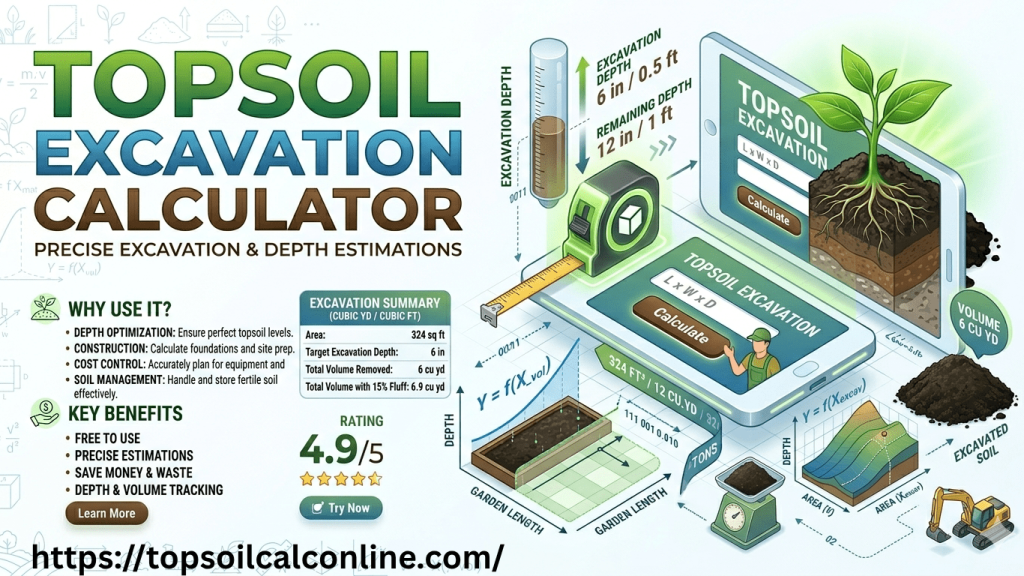
Most people starting a landscaping job, a build, or a site prep forget one thing.
Excavation gives you more soil than you planned for. Always. That extra dirt means extra removal cost. More time on the job. And the stress of figuring out where to even begin.
This soil removal calculator gives you a real estimate of how much you’re actually moving based on your area and how deep you’re digging. Whether you call it a dig-out calculator, a soil removal calculator, an excavated soil calculator, a spoil removal calculator, a muck away calculator (if you’re in the UK, Ireland, or Australia), or just a quick way to calculate dirt removal before you start — it does the same job. Gives you the number before the problems do.
Stripped topsoil is worth keeping, so see how topsoil forms and why it takes so long to replace before you haul it away.
Laying a lawn.
Leveling ground.
Putting in a driveway.
Improving drainage.
Digging a foundation.
Whatever the job is — knowing your excavation volume before you start keeps you from hitting surprises that stop everything cold.
What Is Topsoil Excavation?
Excavation means cutting into the ground and moving that soil somewhere else. Going down to a set depth. Creating a slope. It’s the opposite of filling — you’re taking soil away, not bringing it in.
You need to excavate when you’re:
- Laying a new lawn or installing sod
- Building a driveway or walkway
- Setting foundations and footings
- Digging drainage trenches
- Leveling uneven or sloped ground
- Getting rid of damaged or contaminated soil
Here’s what shocks most people. Even pulling out a few inches across a large area produces a massive amount of soil. Way more than you’d picture standing there looking at the ground.
That’s why topsoil removal needs to be calculated before the problems start — not after.
How To Calculate Soil Removal Volume
The math is simple. Measure your length with a tape, multiply by width, then multiply by depth. That gives you your excavation volume.
The calculator handles unit conversions itself. Inches to feet, cubic feet to cubic yards — you don’t need to think about any of that.
Results show in cubic yards by default. That’s what contractors work with, what dump trucks are measured in, and what disposal sites use across the US. Cubic meters are there too for projects outside the US.
If you want to know your excavation weight in tons instead of just yards, the calculator above now does this automatically — it applies the standard 1 to 1.4 tons per cubic yard range (topsoil, depending on moisture) to your bank volume and shows you a weight range alongside your cubic yardage.
Works great for rectangular and square areas. If your site has irregular shapes or multiple zones, use a multi-area calculator instead. You’ll get a better number that way.
How much topsoil to remove for a driveway?
A driveway typically needs 6 to 8 inches of excavation depth to allow for sub-base material and surface layer. For a standard 2-car driveway around 400–500 square feet, that works out to roughly 7–10 cubic yards of soil to remove. Put those numbers into the calculator above and it gives you your exact figure.
How much soil to remove for sod or turf installation?
Sod and turf jobs only need a shallow strip — typically 1 to 2 inches of old grass and topsoil removed before laying new sod. For a 1,000 sq ft lawn at 1.5 inches deep, that works out to roughly 4.6 cubic yards of soil to remove. Use the 4-inch topsoil strip preset above as a starting point, then dial the depth down to match your actual sod removal depth.
Why Excavated Soil Expands After Removal
The biggest reason excavation jobs go over budget is soil swell. You might hear it called bulking.
Soil in the ground gets packed tight over years under its own weight. The moment you dig it out it loosens up. Spreads out. Takes up more space than it ever did underground.
How much does soil expand when excavated?
- Excavated soil typically expands 20 to 30 percent in volume
- Clay soil swells more than sandy soil
- Wet soil swells even more than that
So you dig out 10 cubic yards. You end up with 12 or 13 cubic yards of loose material sitting there. More truckloads. More disposal runs. More money gone.
Ignore soil swell and your dirt removal cost estimate will be wrong. Every single time.
Estimating Truckloads for Excavated Soil Removal
Once you know your excavation volume, the next question is how many trucks to move it all.
Smaller dump trucks carry around 10 cubic yards. Standard ones run 12 to 14.
Soil never loads perfectly. Trucks have legal weight limits. So contractors always round up. Planning one extra load before you start is a lot better than running short and watching the job sit half done. The calculator above now estimates this truckload count automatically, using a standard 12-cubic-yard dump truck and your post-swell volume — swap in your own hauler’s truck size for a more precise number.
Got more than one excavation zone? Different depths in different spots? Calculate each zone separately. Your total will be much closer to what actually shows up on the day.
If you need a quick way to estimate removal costs, most dirt removal services charge per truckload or per cubic yard — so your volume number from this calculator feeds directly into that conversation. Prices vary by region, but having a solid cubic yard figure means you can get accurate quotes instead of rough guesses. Searching for a dirt removal service near you with that number already in hand makes the whole process faster.
How Much Does It Cost to Remove Dirt or Topsoil?
Costs vary by region, but as a general guide, dirt and topsoil removal typically runs $50 to $100 per cubic yard, or roughly $150 to $400 per truckload, once hauling and disposal/tipping fees are included. Clean fill dirt with no debris usually costs less to dispose of than contaminated or mixed soil.
| Removal method | Typical cost |
|---|---|
| Per cubic yard (hauled + disposed) | $50 – $100 |
| Per truckload (10–14 cu yd) | $150 – $400 |
| Excavation/digging labor only (per cu yd) | $10 – $25 |
Use your volume number from the calculator above to get an accurate quote instead of a rough guess. For a fuller breakdown, the topsoil cost calculator handles the full price side of the equation.
Common Topsoil Excavation Mistakes to Avoid
Most excavation problems start with one small planning mistake. And the same mistakes show up job after job.
- People forget to account for soil swell
- They dig deeper than the job actually needs
- They mix up their excavation estimate with their topsoil delivery estimate
- They underestimate topsoil removal cost and forget how much work it takes just to get that soil off site
- And they assume the dug-out soil can be reused right there — most of the time it can’t
Spot these early and you save real time and real money. On big projects one small mistake doesn’t stay small for long.
When to Use Other Calculators
This soil excavation calculator does one job — it tells you how much soil needs to come out.
But depending on where you are in your project, other tools help too.
- Bringing soil back in after digging? Use the topsoil calculator.
- Need to figure out delivery and hauling capacity? Use the truckload calculator.
- Want to know what materials and transport will cost? Use the cost calculator.
- Got an irregular site or multiple zones? Use the area or multi-area calculator.
Right tool for the right stage. That’s all it takes.
Frequently Asked Questions
The amount depends on the area and depth being excavated. Even shallow excavation over a large surface can produce several cubic yards of soil.
Soil expands once removed from the ground because it is no longer compacted. This expansion typically ranges from 20–30%.
This depends on the total excavated volume and truck capacity. Most projects require rounding up to avoid underestimating haul-off needs.
Yes. Adding an allowance for soil expansion and uneven excavation is strongly recommended.
In some cases, excavated topsoil can be reused for landscaping or grading, but this depends on soil quality and project requirements.
Dirt and topsoil removal typically costs $50 to $100 per cubic yard, or roughly $150 to $400 per truckload, once hauling and disposal fees are included. Prices vary by region and by how far the material has to travel.
They’re all the same job described with different regional terms. “Spoil removal” and “muck away” are common in the UK, Ireland, and Australia, while “dirt removal” and “soil removal” are more common in the US and Canada. Whatever it’s called locally, the calculation is the same — volume in, truckloads and tons out.
Weight depends on the bank volume before swell, not the loose, bulked volume. As a rule of thumb, multiply your cubic yards by 1 to 1.4 tons per cubic yard for topsoil. The calculator above does this automatically once you enter your measurements.
Final Thoughts
Getting your excavation volume right is one of the most important steps in any landscaping or construction project. Skip it and the problems show up later when they cost more to fix.
This topsoil excavation calculator helps you plan your soil removal realistically. It accounts for depth, swell, and how much needs to be hauled away.
With solid numbers in hand, you avoid delays, keep your costs under control, and move into the next phase of your project without second guessing yourself.

Daniel
Founder & Editor – TopSoilCalcOnline.com
Daniel is the founder and primary editor of TopSoilCalcOnline.com, a practical resource built to help homeowners, landscapers, and contractors accurately calculate topsoil, compost, and soil mix requirements. With hands-on experience in lawn preparation, raised beds, topdressing, and bulk soil planning, Daniel focuses on turning complex volume calculations into simple, reliable tools. Every calculator and guide on this site is designed to reduce material waste, prevent over-ordering, and help users plan landscaping projects with confidence and precision.
This calculator is an absolute lifesaver for quoting earthwork! People always forget that dirt expands once you dig it out of the ground. Does this topsoil calculation account for a standard 15-20% swell factor when estimating haul-off truck volumes, or should we manually add that to the total?