
Topsoil Truckload Calculator
Estimate how many truckloads of topsoil you need based on total volume and common dump truck capacities.
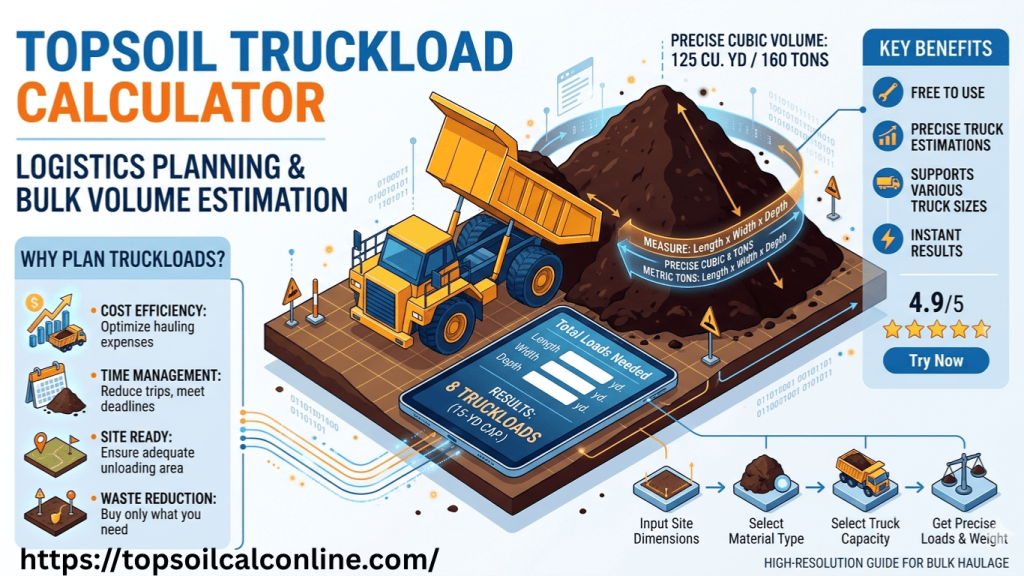
If you have ever bought topsoil before, you probably remember that moment when the seller asked — how many truckloads do you need?
And just like that, you’re stuck. Too little and you run short. Too much and you’ve wasted money on soil sitting in a pile you don’t need.
That’s exactly where this topsoil truckload calculator helps. You put in your area and depth, it tells you how many dump trucks you actually need based on your volume and the truck’s capacity. No guessing, no awkward back and forth with the supplier, no expensive mistakes.
What Is a Truckload of Topsoil?
A truckload is simply the amount of soil one truck can carry in a single trip. It’s usually measured in cubic yards. But here’s the thing — there is no standard truckload size. The actual soil volume depends on the truck, local weight limits, and what equipment your supplier runs.
Before you book a delivery, it helps to know how to judge topsoil quality, including whether it is screened and where it was sourced.
In the US, most residential deliveries use a standard dump truck that carries somewhere between 6 and 14 cubic yards. Smaller trucks carry less. Larger tri-axle trucks carry more but they can’t always get into tight driveways or narrow streets.
This difference matters more than most people think. If you assume every truck holds the same amount, you can easily miscalculate your order and end up short on delivery day.
What Are Common Topsoil Truck Sizes?
Most suppliers in the US and international markets offer a few standard truck sizes. Here’s what you’ll typically come across when placing an order:
| Truck Type | Capacity (cu yd) | Approx. Weight (tons) |
|---|---|---|
| Pickup truck | 1–2 | 1–2.8 |
| Small dump truck | 6 | 6–8.4 |
| Standard dump truck | 8 | 8–11.2 |
| Large dump truck | 10 | 10–14 |
| Tandem axle truck | 10–12 | 10–16.8 |
| Tri-axle truck | 12–15 | 12–21 |
Weight ranges assume topsoil at 1–1.4 tons per cubic yard depending on moisture content. Actual truck capacity varies by supplier and local road weight limits.
Tri-axle dump truck capacity deserves a specific mention. A tri-axle can typically carry 12 to 14 cubic yards of topsoil per load — sometimes up to 15 yards of loam depending on soil weight and local road limits. If your supplier runs tri-axles, a single delivery can cover a lot of ground. But those trucks are large — make sure your site can actually receive one before you order.
Tandem axle trucks sit between the two — typically 10 to 12 cubic yards — a common middle-ground choice when a standard truck is too small but a tri-axle can’t access the site.
What about a pickup truck?
If you’re hauling your own soil, a standard full-size pickup truck holds roughly 1 to 2 cubic yards of topsoil depending on bed size and weight capacity. A half-ton truck is typically limited to around 1 cubic yard; a three-quarter or one-ton truck can handle closer to 2 yards. Worth knowing if you’re doing a small project and skipping delivery altogether.
Something else worth knowing:
These numbers reflect volume, and weight matters just as much. Topsoil typically weighs around 1 to 1.4 tons per cubic yard depending on moisture content. Wet topsoil is significantly heavier than dry. Because trucks have legal weight limits, a wet load sometimes can’t be filled to full capacity — so the actual amount delivered can vary a little from what’s on paper, even between suppliers offering the same truck size.
How Many Tons Is a Truckload of Topsoil?
A typical dump truck load of topsoil weighs between 6 and 21 tons, depending on truck size and moisture — a standard 8-yard load weighs roughly 8 to 11 tons, while a full tri-axle load can weigh 12 to 21 tons. Use the table above to match your truck size to its approximate weight range, or check the calculator’s result for an estimate based on your own volume.
How the Topsoil Truckload Calculator Works
This topsoil calculator uses cubic yards as its base unit. You enter your total soil volume — in cubic yards or cubic meters — then select the truck size your supplier uses. It divides your volume by the truck capacity and rounds up to give you the number of truckloads you need.
Here’s a simple example. Say your project needs 18 cubic yards and your supplier runs 9-yard trucks. That’s exactly two truckloads. Simple math — but the kind of thing that’s easy to get wrong when you’re trying to work it out in your head while placing an order.
Running this before you call your supplier takes two minutes. Getting it wrong costs you an extra delivery.
How Much Area Does One Truckload Cover?
One question almost everyone asks — how much area can one truckload actually cover?
The honest answer is it depends entirely on depth.
Here’s a simple rule to keep in your head:
- One cubic yard covers around 324 square feet at 1 inch deep
- That same cubic yard covers only 108 square feet at 3 inches deep
So a 10-yard truckload can cover 3,000 square feet at a light top-dressing depth. But that same truck covers less than 1,000 square feet once you go down to 3 inches.
This is why depth planning matters just as much as truck size. Two people can order the exact same truckload and get completely different results — just because one went deeper than the other.
Get your depth right before you order. That one decision changes everything.
How Much Does a Truckload of Topsoil Cost?
This varies a lot by region, soil quality, and delivery distance — but having a rough benchmark helps before you call.
A standard 8–10 yard dump truck load of topsoil typically costs anywhere from $150 to $500 or more, including delivery. Screened or premium topsoil costs more than unscreened fill. Local suppliers near you will often be cheaper than those delivering long distances, which is why searching for topsoil by the truckload near you almost always gets you a better rate than buying from a regional distributor.
If you want a full cost breakdown including delivery fees, use the topsoil cost calculator instead — it’s built specifically for that.
For dated example prices and a worked delivery-cost table, see our guide to how much topsoil costs.
A Smart Truckload Calculation Example
Let me break this down with actual numbers.
Spreading one inch of topsoil on a 1,000 square foot lawn needs about 3 cubic yards. One small 6-yard truck gets that done with room to spare.
Now say your project needs 20 cubic yards. Your supplier runs 10-yard trucks — two loads and you’re done. But if his trucks only hold 8 yards, that same job now takes three loads.
Nothing changed about your project. Just the truck size.
But that third load hits your wallet. It pushes your delivery date. It adds time to the job. That’s why knowing your cubic yards per truckload before you call the supplier saves you from a headache you didn’t see coming.
Should You Order Extra Topsoil?
Ordering exactly what you calculated rarely works out in the real world.
Topsoil settles after you spread it, especially when it contains organic matter. Add some watering and it compacts even more. Uneven ground, small adjustments, a little spillage here and there — all of it eats into your total faster than you’d expect.
Most experienced landscapers recommend ordering 5 to 15 percent extra. For a small tidy project, 5 percent is enough. For a large or uneven area, go higher.
Yes, that extra soil adds a little to your cost. But it’s nothing compared to placing a second order and paying another delivery fee because you came up short on the last stretch of the job.
Common Truckload Ordering Mistakes
Most delivery problems come from one simple wrong assumption.
People order by square meters without converting to volume. They assume every truck carries the same amount. It doesn’t work that way.
Driveway access gets ignored all the time. A big tri-axle truck won’t fit every street. Even when it does, the weight can crack your driveway — remember, a full load of topsoil can weigh 10 to 18 tons depending on truck size and soil moisture. In tight spots a smaller truck just makes more sense, even if it means an extra trip.
Slopes and uneven ground get forgotten too. A sloped area needs more soil than a flat one. If you only calculate the surface, you will come up short. And by the time you realize it, the truck is already gone.
When to Use a Different Calculator
This truckload calculator focuses on delivery planning, not volume measurement.
If you haven’t worked out your total soil volume yet, start with the Topsoil Calculator to work out your total volume first. Get that number right, then come back here.
If you’re buying bags instead of bulk, the topsoil bag estimator gives you a better answer. And if you want to know the total cost including delivery fees, go with the topsoil cost calc.
Each tool does one thing well. Use the right one for where you are in your planning.
Frequently Asked Questions
Most truckloads range from 6 to 12 cubic yards, depending on the truck and supplier.
At 1 inch deep, less than one truckload is usually enough. At 3 inches deep, you may need a full truckload depending on truck size.
That depends on area and depth. Many projects need more than one load, especially at deeper soil depths.
Most residential driveways can handle smaller dump trucks, but large tri-axle trucks may not be suitable.
Larger truckloads usually cost less per cubic yard, but access and weight limits can make smaller loads more practical.
Topsoil weighs about 1 to 1.4 tons per cubic yard, so an 8-yard truck carries roughly 8 to 11 tons, and a 12-yard tri-axle load can weigh 12 to 21 tons depending on moisture.
Tandem axle trucks typically carry 10 to 12 cubic yards of topsoil, putting them between a standard dump truck and a tri-axle rig — a common choice when a standard truck is too small but a tri-axle can’t access the site.
Final Thoughts
Once you understand truck capacity and volume, ordering topsoil gets a lot easier. No confusion, no back and forth with the supplier, just a clear number you can order with confidence.
This calculator keeps you from ordering too little or too much. Both cost you money. Both cause headaches you don’t need.
Use it before you plan, not after you order. That one step helps you make a smarter call for your project.

Daniel
Founder & Editor – TopSoilCalcOnline.com
Daniel is the founder and primary editor of TopSoilCalcOnline.com, a practical resource built to help homeowners, landscapers, and contractors accurately calculate topsoil, compost, and soil mix requirements. With hands-on experience in lawn preparation, raised beds, topdressing, and bulk soil planning, Daniel focuses on turning complex volume calculations into simple, reliable tools. Every calculator and guide on this site is designed to reduce material waste, prevent over-ordering, and help users plan landscaping projects with confidence and precision.